
Industries
Key takeaways
- A tokenized card number is not encrypted data: it has no mathematical relationship to the real account number, so a full database breach yields nothing anyone can spend.
- Network tokenization pays for itself in approvals, lifting authorization rates by 3% to 6% before a single fraud saving is counted.
- Tap-to-pay schedules break on certification, not code: Host Card Emulation approval and token requestor onboarding routinely add eight to twelve weeks that cost estimates omit.
- The super-app question is a distribution decision, because wallet features only compound inside an app that already owns daily-habit traffic.
- Budget USD 25,000 to USD 60,000 for a basic wallet and USD 70,000 to USD 250,000 for an enterprise build, across a 3 to 12 month timeline.
What does mobile wallet app development actually involve?
Mobile wallet app development is mostly not app development. The user-facing build (card list, tap screen, transaction history) is the small part. What sets the budget and the schedule is credential handling: provisioning cards as network tokens, passing the certifications that let a phone speak to a payment terminal, and standing up the compliance perimeter (PCI DSS scope, KYC and AML checks, data residency rules) before a single live card is loaded.
The scale explains the interest. About 4.4 billion people now use a digital wallet, up from roughly 3.4 billion in 2023, with forecasts pointing to 6 billion by 2030.1 Industry aggregators put mobile wallet payment value on track for USD 10 trillion, already carrying the majority of online purchase value.2
Two decisions set everything downstream: whether the wallet holds value or only holds credentials, and whether it is a product in its own right or a feature inside something larger. Both are answered below.
Digital wallet or mobile wallet: what is the difference?
A digital wallet is any software store of payment credentials, including browser and server-side wallets. A mobile wallet is the subset that lives on a phone and can pay in the physical world, normally over NFC. The distinction is not pedantic. The moment a wallet claims tap-to-pay it inherits secure hardware dependencies, scheme certification and an app store review path that a browser-only wallet never touches.
Three product shapes sit under the same label, and their cost profiles are not comparable.
| Wallet type | What it holds | Main build burden |
|---|---|---|
| Pass-through | Tokenized references to cards the user already has | Token requestor onboarding, device attestation, certification |
| Staged or closed-loop | A stored balance you issue and owe | Ledger accuracy, money transmission licensing, reconciliation and settlement |
| Issuer wallet | Cards you issue inside your own app | Processor integration, disputes and chargebacks, statementing |
Most teams who say they want their own Apple Pay mean the first row. It is the cheaper path, the faster path, and usually the correct one. The second row changes the company, not just the product: holding customer funds makes you a regulated entity in every market you serve.
Why tokenization, not encryption, is the core of wallet security
Tokenization replaces a card number with a surrogate value that has no mathematical relationship to the original. Encryption is reversible with the right key. A network token is not reversible at all, because the mapping between token and real account number lives only inside the card network’s vault. A complete breach of your database therefore yields strings that cannot be spent outside the device, merchant or transaction context they were minted for.
In practice the flow runs like this. The user adds a card. Your app, acting as a token requestor, asks the network’s token service to issue a device-bound token. The issuer approves, sometimes after a step-up check. Your systems then store the token reference and a set of keys, never the account number. That single architectural choice is what keeps most of your infrastructure out of PCI DSS scope, which is worth more than any point security control you could buy.
The volumes behind this are no longer experimental. Visa has issued more than 10 billion tokens since 2014, generating over USD 40 billion in incremental global e-commerce value, and reports USD 650 million of fraud avoided in a single year through tokenized transactions.3 Tokenized transaction counts are projected to roughly double, from 283 billion in 2025 to 574 billion in 2029.4
Tokenization is a revenue argument as much as a risk argument, which is how it should be sold internally. Network tokenization is associated with a 3% to 6% increase in authorization rates, and Visa has reported a 4.6% lift for tokenized card-not-present credentials against non-tokenized ones.5 Industry analysis credits EMV and tokenization with cutting card-present fraud by 87% and digital payment fraud by 67% since adoption became widespread.6 Coverage keeps widening: tokenization is expected to reach 85% of global ecommerce transactions by 2028.4
Successful wallets rarely try to replace the card rails. They win by being the best token requestor and the best interface on top of rails that already work, because replacing those rails means becoming a licensed money transmitter in every jurisdiction you operate in.
How does tap-to-pay work, and what actually slows it down?
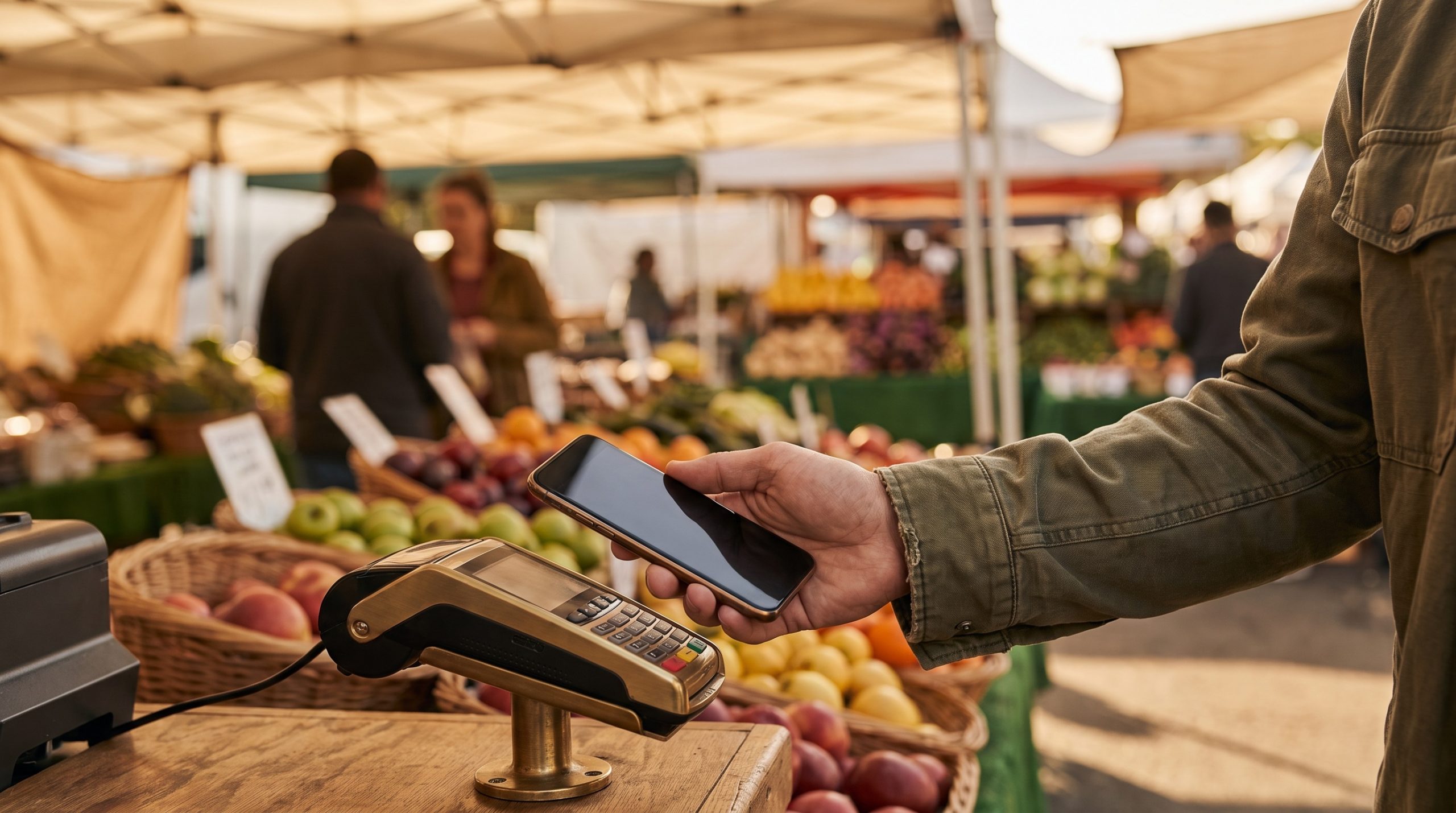
Tap-to-pay is a short-range NFC exchange. The phone and the terminal establish a link within a few centimetres, the wallet presents a tokenized credential plus a one-time cryptogram, and the terminal routes that to the acquirer as an EMV contactless transaction. On iOS the credential is held in the Secure Element. On Android, Host Card Emulation lets the application present the credential from software, with keys protected by the platform and limited-use keys refreshed from your server.
The mechanism is well documented and rarely the problem. The schedule risk is procedural. In practice, Host Card Emulation certification and per-network token requestor onboarding with the card schemes routinely add eight to twelve weeks, and almost no published cost estimate accounts for that time. Teams who treat certification as a launch-week formality lose a quarter. Run it as an engineering workstream that starts in month one, in parallel with the mobile engineering build rather than after it.
A related question comes up in every kickoff: is Apple Pay or Google Pay integration required? No. A wallet can run independently for online payments, in-app payments and closed-loop acceptance. But for broad in-store acceptance on iOS, going through Apple’s payment framework is the practical route, and that constraint belongs in the roadmap before the design phase rather than after it.
Which digital wallet features matter in 2026?
Feature checklists age badly. The ones that still separate wallets are tied to trust and to frequency of use.
- Instant provisioning. A card that takes three screens and an SMS code to add loses users at the first step. Push provisioning from the issuer app is the benchmark to design against.
- Biometric entry, correctly framed. Around 80% of digital wallets globally used biometric authentication in 20257, and biometrically authenticated remote mobile payments are forecast to grow 383% between 2022 and 2027, reaching 39.5 billion transactions.8 Treat biometrics as a speed layer on top of tokenization and device attestation, not as a security control in itself. The match normally happens locally on the device and the biometric never travels.
- Spend controls and instant freeze. The cheapest trust feature in the product. Users judge safety by what they can switch off themselves.
- Passes beyond payment. Tickets, loyalty and access credentials raise open frequency without adding licensing. Wallet passes have become a standard channel for ticketing and venue access.
- Real-time fraud scoring. Device, velocity and location signals scored at authorization catch what static rules miss. This is where applied AI earns its place in a wallet, well ahead of any chat interface.
- Honest failure states. Declines, weak connectivity and expired tokens are the moments that decide retention. Design those screens first, not last.
Should the wallet be standalone or a super-app module?
The super app market was estimated at USD 114 billion to USD 127 billion in 2025, with projected growth of 20% to 30% a year into the early 2030s.9 Gartner has estimated that by 2027 more than half the global population will use multiple super apps daily.10 Numbers like those pull a lot of roadmaps toward bundling.
Read the super app question as a distribution decision before a product decision. Super apps work where one platform already owns daily-habit traffic: messaging, ride-hailing, food delivery, marketplace commerce. The wallet monetizes attention that exists already. Bolting wallet features onto a low-frequency application, an annual insurance renewal or a quarterly B2B portal, does not reproduce that effect. It only adds a compliance surface to a product that was never built to carry one.
A workable test: if your app is not opened at least weekly by a majority of active users, build the wallet as a focused standalone product, or embed it with a partner who already has the traffic.
What does mobile wallet app development cost, and how long does it take?
Development agency estimates put a basic mobile wallet at roughly USD 25,000 to USD 60,000, with mid-market and enterprise builds running USD 70,000 to USD 250,000 or more, over a 3 to 12 month timeline.11 Treat those figures as the software line only.
Four costs sit outside almost every quote.
- Certification and network onboarding, the eight to twelve week lead time above, which is priced in team months rather than as a fee.
- PCI DSS assessment, plus the architecture work needed to keep card data out of scope in the first place.
- KYC and AML tooling and the operations people who work the alerts. This is a recurring cost, not a project cost. Teams who have shipped under HIPAA will know the pattern from building compliant apps in healthcare, where control design, not feature count, sets the timeline.
- Support and dispute handling. Payments generate contact volume that unfunded roadmaps quietly ignore.
The global mobile wallet market itself was valued near USD 12.85 billion in 2025, with forecasts around USD 104.69 billion by 2034.12 Capital is rarely the constraint on these programmes. Sequencing is.
A build sequence that removes the usual surprises
Order the work so the slowest external dependency starts first.
- Decide the wallet type and the jurisdiction map. Licensing scope follows from this and from nothing else.
- Open token requestor conversations with the card networks in week one, before the design sprint.
- Set the token and key architecture before any screen design, so PCI scope is chosen deliberately rather than inherited.
- Build provisioning and authentication end to end on one card scheme, prove it, then add schemes.
- Certify contactless while the rest of the application is still in build.
- Instrument declines, provisioning drop-off and fraud outcomes from day one. In month two these are the only metrics that matter.
Most teams weighing a full wallet against a lighter payments integration are better served by a two-week architecture review than by a discovery phase. If that is where you are, talk to our engineering team.
Frequently asked questions
How much does it cost to build a mobile wallet app in 2026?
Development agency estimates put a basic mobile wallet at roughly USD 25,000 to USD 60,000, with mid-market and enterprise builds at USD 70,000 to USD 250,000 or more. Timelines run 3 to 12 months depending on scope. Those figures cover software only, so add certification time, PCI DSS assessment, KYC and AML tooling, and the operations staff who work fraud alerts after launch.
Is tokenization the same as encryption?
No. Encrypted data is reversible with the correct key, so it stays sensitive wherever it is stored. A network token is a surrogate value with no mathematical relationship to the underlying card number, and the mapping lives only inside the card network's vault. That is why tokenization removes most of your infrastructure from PCI DSS scope while encryption alone does not.
What compliance is required to launch a mobile wallet?
At minimum, PCI DSS obligations scoped by how much card data your systems touch, KYC and AML checks on users, and privacy law compliance such as GDPR wherever you have European users. If the wallet holds a stored balance rather than referencing existing cards, money transmission or e-money licensing applies in each jurisdiction you operate in. Decide the wallet type first, because the licensing scope follows from it.
Do I need Apple Pay or Google Pay integration, or can a wallet run independently?
A wallet can run independently for online payments, in-app payments and closed-loop acceptance at your own merchants. Independence stops at broad in-store acceptance on iOS, where going through Apple's payment framework is the practical route. Settle that constraint during roadmap planning rather than during design, because it shapes what the contactless experience can look like.
What are the biggest security risks in a mobile wallet app?
Account takeover at the provisioning step is the largest, because a fraudster who loads a stolen card into a legitimate device inherits all the trust that device carries. Compromised or rooted devices, social engineering of one-time codes, and over-broad PCI scope caused by storing card data you never needed are the other three. Biometrics reduce friction but do not address any of these on their own.
How long does tap-to-pay certification take?
Host Card Emulation certification and per-network token requestor onboarding with the card schemes commonly add eight to twelve weeks. That time is procedural rather than technical, so it cannot be compressed by adding engineers. Start it in the first month of the programme and run it in parallel with the application build.
Sources
- Capital One Shopping Research: Digital Wallet Statistics, 2025. capitaloneshopping.com
- ElectroIQ: Mobile Wallet Statistics, 2025. electroiq.com
- Visa: Newsroom press release on payment tokenization milestone, 2024. usa.visa.com
- Visa Corporate: Tokenization knowledge hub, 2025. corporate.visa.com
- Visa Acceptance Solutions: Tokens are key to future-proofing payments, 2025. visaacceptance.com
- Coinlaw: Payment Tokenization Statistics, 2025. coinlaw.io
- iProov: Biometric Statistics (Goode Intelligence aggregation), 2025. iproov.com
- Goode Intelligence: Biometric Payments Market, Technology Analysis, Adoption Strategies and Forecasts 2025 to 2030, 2025. goodeintelligence.com
- IMARC Group: Super Apps Market, 2025. imarcgroup.com
- Adjust: State of Super Apps (citing Gartner), 2025. adjust.com
- Cleveroad: E-Wallet App Development Cost, 2025. cleveroad.com
- Citrusbug: Mobile Wallet Statistics, 2025. citrusbug.com

Written by the group's editorial team with the practice leads who run these builds. Reviewed before publish. Spotted an error? Tell us and we will fix it.